Sunday, 28 December 2014

What Happens When Malware Infects Your Computer And Creates Thousands Of Fake Clicks On Ads


Online ad fraud costs advertisers more than $7 million every month, as they pay for digital ads that were never actually seen by humans.
Much of this online ad fraud is created by botnets: armies of PCs infected with malware that generates thousands of fake clicks on ads. The botnet controllers tend to be unethical web publishers that want to ramp up the prices of advertising on their sites by inflating the amount of clicks on their sites.
Ad fraud has a number of drastic consequences. For users, it can significantly slow down their machine. For advertisers, it means they have to pay more to actually generate meaningful results from their online advertising. And for ethical publishers and advertising technology companies, it diminishes trust in the digital advertising industry, which could lead to less spending.
But while the consequences for all those involved are dire, it can be difficult to really understand how ad fraud works in practice.
That’s why fraud detection company Forensiq has created a video to highlight just how quickly a computer infected with malware can start racking up thousands of false ad impressions.

NotCompatible’ Malware turning Android smartphones into slave armies


Lookout, A mobile security firm warned about a new malicious virus ‘NotCompatible malware’ that can harm Android-powered smartphones or tablets and remote them for their dirty work like spamming users, carrying out click-fraud,  automated exploitation and fraudulent online ticket purchasing etc.
Lookout has confirmed that  more than 4 million phones in the U.S. have been turned into botnets this year as a result.
Lookout firm was tracking the evolution of  this malware from last past two years. On that time ‘NotCompatible malware’ is used as a proxy to run spam campaigns or scalp concert tickets.  After sometime hacker revealed NotCompatible.A, was relatively simplistic architecturally, NotCompatible.C is a changed beast in terms of the technological concepts it uses to stay alive.

How NotCompatible malware spreads ?

NotCompatible malware spreads onto smartphones by infecting a legitimate website and when users visit that website from their phone, they unwittingly download the malicious code.
NotCompatible malware typically introduces itself as an Android system update and asks for permission to install in mobile devices. One way to safeguard against infection is to decline such prompts and go through smartphone settings to check for system updates.
The most common way for the virus to get on a smartphone is by visiting legitimate websites that have been hacked and then booby-trapped to secretly infect visitors, according to Lookout security researcher Jeremy Linden.
This particular strategy is “one of the first times hacked websites were used at a large scale to specifically target and infect mobile devices,” said Tim Strazzere, Lookout’s lead research and response engineer, in a blog post.
Using the NotCompatible proxy, an attacker could potentially do anything from enumerating vulnerable hosts inside the network, to exploiting vulnerabilities and search for exposed data.

Saturday, 27 December 2014

TOX: A SECURE VERSION OF SKYPE TO AVOID NSA SPYING ON YOU


When Edward Snowden revealed to the full extent what the NSA were up to last year, people started talking about the need for a more secure alternative to Skype. This started a relatively new project made up of programmers who frequent 4Chan and Reddit are working on an open source, security-focused Skype replacement.
The project is called Tox, and is yet another example of programmers uniting in the post-Snowden era to make easy-to-use tools with encryption and privacy considerations built-in.
“Nowadays, every government seems to be interested in what we’re saying online. Tox is built on a ‘privacy goes first’ agenda, and we make no compromises. Your safety is our top priority, and there isn’t anything in the world that will change that,” states the Tox website. The team will also hire a security firm to test the encryption to ensure it is secure.
The Tox team is focused on building a Skype replacement, the main thing they’re trying to do, besides provide encryption, is create a tool that requires no central servers whatsoever . It relies on the same technology that BitTorrent uses to provide direct connections between users, so there’s no central hub to snoop on or take down.      - Rejected Nuts

You can't hack facebook using softwares or websites!!

Hacking Someone's Facebook Password Using Some Software Or Website? No ,You Can't!


You will be aware of the thousands of website and softwares available online that claim to Hack any Facebook Account. They'd ask you the victim's profile ID, maybe your credentials and some money too and will reportedly tell you the password which, to be honest, never works. Ever wonder why? Let me tell you why, they're FAKE! They're a scam which tricks you somehow in losing your money or your own Facebook account. Just give it a thought,that why would Mark Zuckerberg and his team would spend Billions of Dollars on Facebook if one could hack it in less than a minute? Today, we'll take a look at this topic with some example websites and software and get the answers to some common related questions.

******************************************************************
THE FACEBOOK HACKING WEBSITES AND SOFTWARES
******************************************************************

Let's start with some examples here. I googled the subject and picked the top results without order. Didn't care to search harder because there are thousands such and I know that all are FAKE and doesn't work!!

So let's look at this GETFBHACK.com.


Their FREE Facebook hacker program is said to be capable of cracking the password of any Facebook user within a day. Sounds cool, I could try it out, but my Norton Antivirus rejected the file straight away and said it as malware! 

I also picked up another one. This Hack-Fbook-Password asks me to enter the profile ID of a user and it will crack the password. I said Okay and began the process.


It ran certain algorithms to determine the password and finally landed me on a page that said I could DOWNLOAD the password IF I fill an online survey first. It was looking quite real.Those of you who've been redirected to surveys would know they don't work and are put just so to get traffic and earn money.


I said maybe I should leave the website now but hey, they gave me a prize!


So I just became the luckiest person in my city just like that! HUH! REALLY ANNOYING!!

Now tell me, how can a sane person believe in all this?

***********************************************************************
THE TRUTH BEHIND ALL THESE!
***********************************************************************
Let me get this straight to you, these websites do nothing at all, they just waste your time and are never able to do the job. In fact, downloaded programs just make the situation worse when you run them. I had my Quickheal Antivirus to guard me otherwise I could be in severe danger currently.

These software are mostly keyloggers , or phishing links and tracking programs that record your keystrokes and action and steal personal information from your computer in the background and send it to their master servers. So ultimately a hacker wannabe gets hacked, how ironic!

From now on in the post, I'll be using the word 'Hacker' for these websites and software since you're no more in the position to be called that.

****************************************************************
WHY ACTUALLY HACKERS DO THIS?
****************************************************************


Setting up websites, maintaining them and developing software is not an easy task and requires a lot of hard work. It requires some money too. So why do these 'hackers' do all the hassle? It's because they get equivalent or more money in return and also many benefits. They can extract your credit card details and other banking info from your system and use it for their advantage. They can hack your account and use it for wrong purposes. Give me one reason why one wouldn't steal money and hack accounts for no loss. ITS THE TRUTH!!

****************************************************************
WHY DO PEOPLE FALL IN THESE TRAPS?
****************************************************************


Why do people try to use such unreal hacking procedures? It's because it's unreal to me, it's unreal to you but not to those who are not much familiar with the working of a software. They get in the web of these hackers and eventually get screwed up pretty bad without consent. 

The websites give guarantees and also portray their 'imaginary' happy customers so as to trick a reader. Such tactics are simple but really powerful and serves to their advantage in most cases. This is also why there are thousands of such websites available.

THEREFORE , NEVER USE THESE WEBSITES OR SOFTWARES AVAILABLE , CUZ NONE OF THEM WORK BUT YOU MAY GET HACKED!!!!

Now-a-days Android Smartphones are backdoors for Hackers to hack your personal stuff


Last week, news was released by Mobile Security Company Lookout based in San Francisco.
Their security researcher Jeremy Linder told AFP (Global News Agency) that, “Malicious malware
NotCompatible is being targeted by hackers to enter into your Android based Smartphones or tablets”.

“Smartphone is becoming the leading computing platform and, because it is everywhere, we
are highlighting malware targeting it”, Jeremy Linder told to AFP.
“Mobile malware are becoming advanced day by day as viruses in PC/Laptop”, Jeremy Linder told to AFP.

Mobile malware are capable enough to leak your location information, your personal data and even all your phone calls records to hackers. Hackers are also able to control malware to operate hacked smartphones to make them Botnet, for hacking websites and for other illegal cyber crime.

Botnet is a collection of Internetconnected programs/malware capable to communicate with other programs to perform tasks as being directed by their boss (Hacker).

Because of malware targeting all devices, different hacked and controlled Smartphones can
communicate with each other with hacker’s directions.


“It is the jackpot when it comes to valuable data, so obviously bad guys are doing a lot of work to get at it,” Jeremy Linden told to AFP.

Usually when you as a visitor unknowingly visit a hacked legitimate website, malware could get download to your Smartphone. So while operating Smartphones, if you stuck with an unknown application or program like NotCompatible prompting for permissions to install. Don’t install it.

For example NotCompatible malware introduces itself as Android System Update. It will prompt you to install Android System Update. Don’t install it as it is being prompted by an unknown application. The easiest way to get protected from this type of malware is to decline such permissions and always configure your default android security settings.
We do recommend you to install good antivirus app like Kaspersky Internet Security. This app is freely available to be download from Google Play Store as trial. Later on you can purchase full version, as if you want Kaspersky Internet Security to protect your Smartphone after trial period end.


Friday, 26 December 2014

Top 7 Facebook Scams which made 8, 50, 000+ victims


Nowadays
Facebook has become the biggest trend of communication with keeping us near to
our friends via Internet since 2004. Across the world, there are more than 800 million users. It has
become habit in our daily life to open our Facebook profile atleast
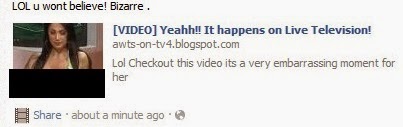
once in a day. Meanwhile it has also become a way for hackers or scammers to spread online scams worldwide. They encourage users to click on pictures, videos or links that user finds attractive like leaked celebrity’s nude pictures or videos. When the user clicks on the link, it redirects them to a malicious website or to a malicious Facebook App. Where he or she doesn’t find the required content but it unknowingly gets shared onto their profile. And, then their friends gets ready to be a victim of the scam.
During the last year 2013 and this year 2014 more than 8, 50, 000+ users become victims to the threats on Facebook. The most famous threats were the malicious applications residing on the Facebook which users unknowingly clicked.
In a two years research preformed by Bitdefender (Internet security company), the company
has revealed that millions of Facebook users are affected by the same Facebook threats
many times.

Top seven most dangerous Facebook scams till 2014
revealed by Bitdefender are as below:

1. Emma Watson’s sexy videos leaked scam (October 2014):


Scammers have taken advantage for the popularity of Emma Watson, to spread Trojan across the
world via Facebook. The leaked sexy videos of Hollywood actress Emma Watson has distributed
more Trojans on Facebook as compare to other images. The curiosity to know about, what is
interesting in the video makes the user to click on the link. And, in turn redirecting them to Trojan
loaded sites, where the harmful Trojan gets installed to the victim’s system.


2. ‘Girl killed by husband because she kissed another men’ (August 2014):


According to Bitdefender’s research, a fake video in which the girl was killed by her husband
because, she kissed another man become a viral across the Facebook. This results in attracting
thousands of Facebook users to be victim of spreading viral by clicking on the video. This video
was the footage of an Asian woman almost chopped off by her husband and it attracts the
attention of teenagers.


3. ‘Funny Videos on Facebook’ Scam (July 2014):


This scam started with a funny video of a Facebook friend. When users clicked on the video, they
were redirected to another YouTube link, which includes malicious flashplayer.exe file as a new
update for visitor browser. Once user clicked on the update link, it was able to retrieve confidential
data and stored passwords from victim browser.


4. Sad video of a women dying during a fight Scam (June 2014):


In this scam video there was a woman who was being beaten to death. When users clicked on the
video, it prompted them to share it with their friends then only they were allowed to watch it. But in
reality, it linked users to moneymaking
surveys after sharing.


5. Facebook ads scam (March 2014):


This scam was used by scammer by showing ads on Facebook Ads network for products like
cheap pharmaceuticals, cheap clothes or cheap mobiles (iPhone) etc. When the Facebook users
clicked on the link it redirected them to the malicious websites. Bitdefender has successfully
researched on the scam with finding around 50,000 malicious websites/domains on the Facebook
Ads network.


6. Naked videos of Facebook friends Scam (March 2014):


The spring of 2014 started with a malicious scam, in which more than 1000 Facebook users had
installed Trojan into their systems for the sake of downloading the naked videos of their Facebook
friends. The countries which got most harm due to this scam were found to be UK, Italy, France
Germany and Romania. Trojan as malware was successfully detected by Bitdefender.


7. Guess who viewed your profile scam (February 2014):


This scam was most popular scam of the Facebook for the year 2014. This scam was carried out
by the scammers in February this year. This scam gave false promises to Facebook users, as
ability to know, ‘Who viewed their profile’. Similar to this, other malicious apps like, ‘Reveals exlovers’
or ‘Profile Viewers’ were shown as official Facebook apps by scammers and made number
of victims. This malicious app as Trojan was capable to post to victim profile, on behalf of the
victim and was also capable of sending victims personal data to the attackers.


SHOCKED ??

So, you have to think many times before you click such kind of strange pictures, videos or links. If
by mistake, you have clicked it and a weird app is requesting for permission as shown in picture
below or asking to share the content. Don’t give permission by clicking on Allow button or don’t
share it. Otherwise malicious app similar to this will be able to post on your profile on your behalf.


Many more exciting Facebook applications are involved in such type of scams, such as promise to
add the feature of dislike button or option to make your timeline look more attractive etc. Don’t
trust such kind of apps, because all these are Hacking Scams and can make you victim.

Rejected Nuts want you to get aware of these scams. So in upcoming year 2015, our visitors
should be able to recognise these scams. Now be smart enough to think before you click on such
type of scams videos, pictures or links.
Make sure you share this article with your friends too, so that they don’t become a victim of such
scams in future.


Searching Alia Bhatt on the internet ?? Be Careful !! This May Be Dangerous . .


Rejected Nuts is presenting special Christmas news for you. It's all about your favourite celebrity "Alia Bhatt". Especially about the “Radha” of the Bollywood, as she is
the most sensational, glamorous and hottest Actress searched on the Internet for the year 2014.

You all know she has made the nation crazy with her movies like “Student of the year”, “2 States”,
“Humpty Sharma ki Dulhania” and with many photo shoots.

McAfee (Computer Security Software Company, part of Intel Security) has revealed the eighth
edition of ‘Most Sensational Celebrity – 2014’ research, where Alia Bhatt is the most searched
celebrity in India for the year 2014. She has replaced Priyanka Chopra, who topped the list last
year and become the most risky personality across the web. If you are looking for sexiest Alia
Bhatt on Internet, then be careful.


The curiosity to know more about Alia Bhatt can make your smartphones/computers a good target
for malwares/viruses. As, the popular search topics of this year like celebrity hot pictures,
wallpapers, celebrity name, free video download and celebrity selfies have resulted in occurrence
of malwareloaded sites. These malwares can allow hackers to steal your passwords and
confidential information.


Venkat Krishnapur, vicepresident
of EngineeringConsumer
and McAfee India Centre said,
“By including the names of popular celebrities in a website’s search tags, consumers are
completely unaware of the security risks that exist which can severely infect their computers,
devices and steal personal data“.

Every year McAfee prepares the list of famous risky personalities. As searching them on the
Internet, you could be redirect to the malware infected websites. The second name in list after Alia
Bhatt is Aamir Khan.


McAfee said, “Users must beware of clicking on third party links and ensure they use web
protection that notifies them of risky sites or links before they visit them.”
Hey folks, control your emotions and secure yourself with good Antivirus before searching for your
favourite celebrity. And also, you need to be careful from clicking malware infected sites.